Sorry about the server outage. It was a technical mistake on my part — don’t worry, Numen isn’t going way. Thanks for all the compliments — the number of people emailing me really did let me know that Numen is a useful and necessary tool. Please continue to report problems! It really helps me out!
X-Rays Open Secrets of Ancient Scrolls
I remember when I was in graduate school, we were all very hopeful that someday such technology would exist and be viable. New original texts of Ancient Latin and Greek would be amazing.
One of the most amazing things about this technology is that the texts would indeed be untouched by the hands of monks and scribes during the middle ages. Why does that matter? The Latin and Greek texts we have today are copies of copies of copies. And like all copies, errors have been introduced. In addition to errors, semi-literate monks may have made corrections that were based on incorrect assumptions about Latin in the centuries prior to their births.
Why not simply unroll the scrolls? Because they are essentially ash. Since the discovery of the scrolls in Pompeii, experts have ruined countless scrolls trying to unroll them. At some point, they were essentially locked in a vault in the hopes that someday technology would advance. It would appear that such a day has nearly arrived.
Felipe Vogel, a graduate student at the University of Kentucky, recently shared his “macronizer” with me. One of our joint efforts will be to improve the results of his tool with a fully declined/conjugated word list from Numen.
Check it out here: Māccer – A Tool for Macronizing Latin Text.
Today I modified the code that Google Analytics uses to keep track of traffic on this site.
That was a major change. Because of the way the internet works, some of Numen’s old data might be cached in your browser — causing weird errors like “AJAX could not be loaded” and other such nonsense.
Fear not — the fix is easy.
Here are several steps you can take to fix the problem in your web browser:
- Log out of Numen and log back in.
- Close your web browser and reopen it.
- Reload the Numen page you’re on by holding the SHIFT key on your keyboard while clicking the refresh button on your browser’s address bar.
- Reload the Numen page you’re on by holding the CTRL key on your keyboard while clicking the refresh button on your browser’s address bar.
- Reload the Numen page you’re on by holding BOTH the SHIFT and CTRL keys on your keyboard (at the same time) while clicking the refresh button on your browser’s address bar.
- Clear your web browser’s cache and then restart it.
- Try another web browser (just to see if it’s happening there, too).
- Contact me at admin@latinlexicon.org.
Pronoun Paradigms
Many of you know that Numen provides a beta paradigm feature. The paradigms of most nouns, verbs, adjectives, and pronouns are available. Generally, they work very well with a couple of well known exceptions (Greek nouns, certain verbal forms, and some irregular forms).
Once upon a time, the pronouns were working fairly well but not so much recently. Over the past few months there has been an uptick in the number of reports of bad pronoun paradigms. After a thorough review, I must note that all pronoun paradigms were broken. Honestly, I’m not sure how that happened. Nonetheless, I took some corrective action this weekend and fixed most of the pronoun paradigms — with the exception of the personal pronouns. Those will take a bit more work because as you probably know, personal pronouns are the only nominal forms in Latin that don’t have explicit gender (i.e., tu does not code for masculine, feminine, or neuter).
So in the meantime, please feel free to spot-check the paradigms for your favorite pronouns and please feel free to report errors. PS, it’s always helpful to cite your source if you believe that a paradigm has an incorrect form. Sources do vary!
Welcome back for Fall 2014
It’s that time of year again — Fall semester has begun! That means this site has begun picking up steam. During summers and other long breaks (spring and the winter holidays mainly), the site takes a sudden downturn while students enjoy their time off. But whenever a new semester starts, visits pick up dramatically. The uptick this year is quite high — almost 40% over last year.
As the years go by, this site gets better and better. More errors are corrected, more features are added, etc. I’m working on a some new features that I hope will benefit everyone greatly — not just students but also the Latin academic community as a whole.
Please continue sharing this site with students and teachers of Latin. I love watching the community grow year after year.
Also, please continue marking errors as you come across them. I can’t fix every single error in a timely manner, but I’ll do my best to get as many as I can. Please keep in mind that some errors are harder than others to fix due to the nature of the computerized database employed here versus the organic nature of a human language like Latin.
In any case, please enjoy your new semester! Good luck!
Numen’s Video Tutorials
Some 2nd Conjugation Errors
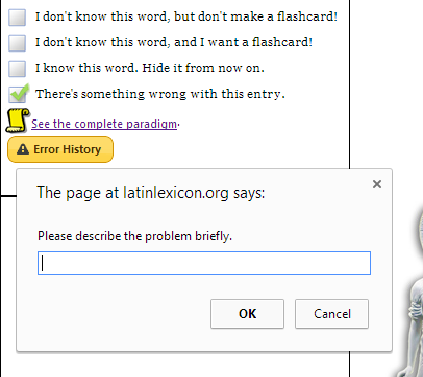
I’m sure most of our regular visitors have noticed a button to report errors that occur in Latin words. We have a great community here and many of you report errors regularly.
One of those errors recently reported was the verb mereō. It turns out that when the dictionary was originally loaded into the database, a few errors crept in. This is normal and as I find the errors, I correct them.
When I was correcting mereō today, I wondered if it were possible that more 2nd conjugation verbs were erroneous — often there is a pattern caused by a programming bug or a data encoding error. After running a quick database query, I discovered that there were indeed 20 or so 2nd conjugation verbs that were listed as 1st or 3rd.
The explanation is simple: in the Lewis Elementary dictionary, occasionally the compound verbs are listed without a macron in the infinitive (exempli gratiā, inhaereō). It is so rare that I never programmed an exception to the rule that said “if an infinitive has a macron, make the verb 2nd conjugation.”
So needless to say I fixed those 20 verbs. Despite that these errors happen every once in a while, I feel that more than 95% of the words in the database are happily error free. Nevertheless, please do continue reporting errors. Someday I’d like to see this dictionary approach 99%+ error-free entries!
Server Move
You know me pretty well by now if you know that I move the Latin Lexicon server every few months. Hopefully this new home will last for a couple of years.
1000 visitors per day!
For the first time ever, Numen has cracked the symbolic high water mark! Yesterday over 1000 visitors came to this site! You can see from the chart below the normal weekend/weekday cycle of the site — there must be quite a few tests coming up this week!
Thanks so much for using this site. As you know, we recently had a lot of server trouble but I’m happy to say that those problems are all cleared up now!
For those of you who don’t know, I continuously correct errors on the site. Although you might find an error now and then, if you report it, I will fix it as soon as I can. Thanks for using this site, and please share it with friends and family, teachers and students, in fact anyone who studies or has a love of the Latin language.