Author: Keith Alexander W.

  • It took almost a year of work to get this new source system online. It’s done! Or at least what clients (that’s you) can see is done.

    As of right now, with any luck, if you look down in the bottom-right corner of your browser, you should see a source box.

    [If not, press SHIFT+F5 on your keyboard or upgrade to the most recent version of your browser or clear  you web cache/temporary internet files.]

    With this new feature you can control which dictionaries your Latin words come from. As of right now, the old Lewis Elementary is online as well as the Lewis and Short Latin Dictionary (the original basis for the OLD). You can also control which priority your words come from.

    This feature is a long time coming, but there still may be bugs. If there are, please let me know! I hope you enjoy this feature.

    Here are a couple of things to note. 1) Macrons are slightly different in the LNS than in the LEM. 2) I haven’t tweaked any of the words in the LNS, so there is potentially a lot more bad data there (which I will eventually fix with your help). 3) Whitaker’s Words and Latinitas Recens will be online soon.

    UPDATE: One thing I forgot to mention is that the LNS includes about 50,000 headwords compared to about 17,000 in the LEM. SO … there are a lot more words!
  • I recently found the need to look up more than just words in English, so I added a feature to the “Search English” page where you can type in a phrase.

    Try typing in something like “in vain.” It’s not perfect, but I think this will help people looking for phrases of a technical, legal, etc. nature.

  • Due to a power outage tomorrow, the server will be down most of the day Monday. It should be back late Monday evening or Tuesday morning. I apologize for the inconvenience.

    Tags:

  • As usual, the semester is a busy time and I can’t spend a lot of time making visible updates. However, as usual, I’m fixing problems in the background as they arise. Mostly what I fix this time of year are definitions as a result of spending a lot of time using Numen to read Latin.

    That brings me to Numen Mobile, which I updated last night. I have been using it a lot lately for studying Latin, and I wanted to open it up to the rest of the world. If you visit Numen on a mobile device, you should notice a link at the top of the screen asking you to try the new mobile site. It’s been tested to work on iOS and Android. It should work in any web browser reasonably well equipped with Javascript, Cookies, DOM, etc. [e.g., technical mumbo jumbo! read: the lastest and greatest].

    If you have an iOS phone, you should be presented with a link that tells you about turning Numen Mobile into a free app on your phone. Just add it to your home screen (shiny new icon and all!) and you’ll find that version works really well (provided you have a stable internet connection).

    That’s it for now. I’m always plodding away, so if it seems like things are dead around here, they’re not!

  • I’ve finished the preliminary data load from Lewis and Short’s “A Latin Dictionary”. For those interested, there are approximately 51500 lemmata* (compared to 17500 in the Lewis Elementary).

    The data is not live for users yet, so you won’t be able to see the new data. But I wanted to tell you about this great breakthrough that I’ve made. The data needs a little bit more massaging to be considered production ready, but it’s very, very clean data so far. I spent several weeks mining the data, and my heuristic algorithms** are getting pretty smart. A few more tweaks!

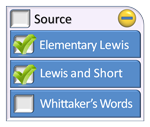
    The big news is how this is going to affect the dictionary. I plan on adding a smart option-box in the bottom right-hand corner that will do two things. 1) List which dictionaries are available for searching and 2) allow the user (that’s you!) to change the order in which they are searched and turn them on or off. You can see my mockup of this concept to the right. (Incidentally, this is my first post with graphics!)

    The biggest benefit of the LNS (Lewis and Short) dictionary is that it contains 3 times the number of words — granted, most of them are proper names and place names, but sometimes it’s nice to know who and where those crazy ancient authors are talking about.

    Keep your eyes peeled. It will only be a matter of weeks until this new data is live!

    *For those who don’t have experience in the field of lexicography, a lemma is a “head word” …
    ** Experience-based methods …

  • What’s going on now? As always, work goes on in the background, but nothing big has changed. Regardless, I want to make sure the front page stays fresh, so this update is to let you know that I continue to make small improvements to the dictionary data and the paradigms that the Latin parsing engine runs on.

    Mostly, I spend a good amount of time correcting bad data, fixing wonky definitions, etc. But from time to time I find an error in a paradigm (for instance, recently I found macrons on -unt verbs) and fix it. Just a few days ago I discovered that short form 3rd adverbs like potenter don’t parse properly; that’s one of my current projects.

    What’s going on in the future? I’m still pulling data out of the big Lewis dictionary. I haven’t loaded it yet because I’m happily discovering that the big Lewis dictionary has a wealth of information that can be extracted. The hard part, as it turns out, is extracting it. I don’t know when the new data will be online, but rest assured I’m working on it often.

    Until next time, feedback is always welcome!

  • I’ve updated the browse pages to be a bit prettier, and with that hopefully a bit more functional.

    As usual, little stuff happens in the background that doesn’t deserve a lot of fanfare, but it does always happen nonetheless!

    Tags:

  • Bad news. Access to the server is down at the moment, and has been for about 2 hours.

    The building where the server is has lost its internet connection. The IT folks said they’re working on it and hope it will be back up with an hour or two.

    Thanks for your patience and understanding!

  • I added noun paradigms to the site. Search or browse for any noun and click on the “See Complete Paradigm” link. Feedback is welcome!

  • This past weekend at CAMWS 2010, I learned a new acrostic acronym from Tom Garvey for the four independent uses of the subjunctive. Since we’re covering that in my Latin 102 class, I’m going to give it a shot. I don’t remember exactly how it went, so my apologies if it’s slightly different from him.

    I – Jussive* (commands)

    P – Possibility

    O – Optative (wishes)

    D – Deliberative (questions)

    * This works because the Latin J was spelled with an I. Also note that this covers the Jussive and the Hortatory. Essentially, these are “polite commands”.

Video Tutorials

Would you like to know how to use this site? Watch LatLex’s video tutorials!